Showing posts with label healthy. Show all posts

Sunday, October 20, 2013

Seedy Surprise Pancakes

When serendipitous pancake inspiration hits,  you gotta go with it. Last week, I unearthed a bag of chia seeds from a cabinet that I'd never opened, and shortly thereafter, saw a recipe in the New York Times for Beet & Chia Pancakes. I had to do it. 

We ran into some friends of friends at the farmer's market out in the country on Saturday and invited them to brunch the next morning. Perfect time to debut a new recipe. So I picked up some beets and had a plan: adapt the recipe to use my sourdough. 


Beet 'n Chia Sourdough Pancakes 

1 large or 2 medium beets (enough for 1/2 cup puréed roasted beets)
1 cup whole wheat flour
1/2 cup white flour
2 tsp baking powder
1 tsp baking soda
1/4 tsp salt
1 tbsp honey (or sugar)
1 1/2 cups sourdough starter (or 1 cup yogurt & 1/2 cup milk)
3 tbsp chia seeds
3 tbsp olive oil 

Roast the beets (washed but skin on) in aluminum foil for an hour in a 350 degree oven. When done, puree in a food processor. Mix together all of the other ingredients and when the beet puree is cool, mix it in. Make and garnish as you would normal pancakes with butter and maple syrup.

These pancakes are utterly delicious. They make a nice surprise for guests. Don't take my word for it, though. Make them yourself! 

Sunday, October 13, 2013

Red Kuri Hummus

New World Bar & Bistro in Albany featured pumpkin hummus on its fall menu last week. I appreciated it, but thought it could have been better. So I made some today from red kuri pumpkin. I think it turned out pretty good.

Pumpkin Chipotle Hummus

2 cups pumpkin, roasted
1/2 cup tahini
1 tsp cumin
1 tsp salt
1/2 tsp pepper
3 tbsp lemon juice
1 tbsp olive oil
2 garlic cloves
small bunch parsley, chopped
1 tsp chipotle pepper

Blend all ingredients in a small food processor to desired consistency. Place a dollop on a plate, drizzle with additional olive oil and sprinkle with chipotle pepper. Serve with carrots and celery.


Monday, September 9, 2013

Bringing the Streets of Jerusalem Home

"Sabih" is the name of this dish from the Tamami & Ottolenghi cookbook Jerusalem. It's roots are Iraqi, but it has elements from many Middle Eastern traditions. One thing is for sure--it's delicious.

I adapted the Jerusalem recipe somewhat, and I think it turned out really well.

Sabih

2 medium-sized eggplants
4 plum tomatoes
2 medium orange tomatoes
2 kirby cucumbers (or one large cuke)
handful of parsley
3 green onions/scallions
3 hardboiled eggs
2 tbsp s'chug or zhoug
1 cup tahini
1 cup yogurt
1 tbsp lemon juice
salt, pepper, olive oil
harissa (if the zhoug isn't hot enough for ya)
pomegranate seeds (optional)
quality pitas (3-4)

Slice the eggplant in half and place the halves, innards up, in a baking dish. Spray with olive oil and season with salt and pepper. I added a little bit of ras-al-hanout, but you could also season with paprika or sumac. Roast in an oven at 375 degrees F until the eggplant is tender, but not mushy. Allow to cool. The Jerusalem cookbook wants you to fry the eggplant; I guess that's traditional, but I needed to bake mine.

Hardboil your eggs (best method here) and begin to make the salad by cubing tomatoes & cucumbers and mixing them with good olive oil, chopped scallions, chopped parsley, and salt & pepper. Allow to rest and marinate for 1/2 an hour to an hour.

Make the tahini sauce by combining tahini, yogurt, and lemon juice and a little bit of salt. This mixture should be thin enough to pour, but not watery.

When the eggplant has cooled, peel the skin and roughly chop the eggplant into cubes. Mix the cubes with the s'chug to taste. The Jerusalem cookbook calls it zhoug, which is typical in a bunch of different cuisines. If you pinpoint it, it might be Yemeni. And you can make it from scratch. Mine is from Sabra, yes, of Sabra hummus. I've had this s'chug in the fridge for about a year--I have no idea why I bought it, but it is GOOD. It's existence in the bottom of the fridge is one of the reasons I chose this recipe. Remember, the s'chug is really hot. And if you want the taste of harissa, too, either eliminate or drastically reduce the s'chug.

Toast the pitas in a warm oven until puffy. You can help this along by spraying a bit of olive oil on the pitas. (Unfortunately, we passed up some fresh-made pitas at the bakery today because we had some in a bag in the fridge. This recipe deserves the best pita possible. Just sayin').

On the toasted pitas, begin assembling by pouring a few dollops of tahini sauce on the warm pitas. Place a few spoonfuls of eggplant on each pita, then layer on the slices of hardboiled egg. Top with a bit more tahini sauce, top with the salad, then place some more tahini sauce on top of that. Garnish with some pomegranate seeds.

I don't know how you eat this thing. I guess on the street in Jerusalem you'd get it in a more user-friendly pita wrapped in wax paper and it would be all rolled up. On our plates, we cut the pitas in quarters and ate it greedily with our hands.

You can get most of these ingredients at Sahadi's if you live in Brooklyn (but they also ship now, too), or maybe at Kalustyan's in Manhattan. But mostly everything you can make from scratch--except the tahini.


Saturday, August 31, 2013

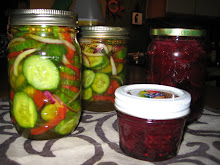
Scotch Bonnet Hot Pickle Relish


My end-of-summer scotch bonnet yield was a neat dozen. I made the third version of hot pepper relish of the season: a sweet hot pickle relish. I hope this one makes us holler.

Scotch Bonnet Pickle Relish

1 large white onion
1 large green bell pepper
4 kirbys
12 scotch bonnet peppers
1 cup cider vinegar
1 cup white vinegar
1 1/2 cups sugar
1 1/2 tsp salt

To prepare, put a pot of water up to boil and fill with your jars & lids. For this amount of veggies, I used four small jars. In another pot on the stove, place your vinegars, sugar, and salt. Turn the heat on the vinegar mixture once your veggies are almost finished with the chopping. Next, in a food processor, pulse the white onion a few times and then add the scotch bonnets.

After those are chopped finely, add the green bell pepper and three of the kirbys. It may take a bit of arranging to get stuff chopped uniformly. Because I like a chunkier relish, I diced the last kirby by hand. Once the vinegar mixture has heated, add the chopped veggies to the liquid and bring to a boil. Boil for about two minutes. Strain the relish, reserving the liquid.

Take the boiled jars out of the pot and place on a clean surface. Spoon very wet relish into each jar. If you like your relish a little more liquidy, you can add some of the strained pickle juice. Seal the jars quickly and set to rest until you hear a "pop." That means the jars are sealed and you can put them up. You can eat the relish right away, but it's best in about a week.

Sunday, August 11, 2013

Hot (Pepper) Mess

Porch peppers beckon, even when you're not feeling well. When they're ripe, they're ripe and you gotta use them or they'll rot. So this weekend was time to make hot pepper relish. Only the red hot peppers were ready; in a week or so, the scotch bonnets will be ready. Those are a whole nother level of hot. I didn't use gloves this time and my hands are burning right now. I can't neglect to use them for the scotch bonnets.

I scavenged all of the old jars that people returned to me after our wedding (jars of hot pepper relish were the wedding favors), washed them in steaming hot water and got started. I rarely write down my relish recipes, but this time I did.


Hot Pepper Relish

One dozen hot red peppers
2 green bell peppers
1 red bell pepper
1 yellow bell pepper
1 large white onion
6 tomatillos
1 tbsp kosher or canning salt
3/4 cup sugar
1 1/4 cup cider vinegar
large saucepan
hot boiling water

Carefully handle the red peppers to cut off the stems and de-seed them.


Chop the vegetables in manageable pieces and in thirds, distribute the veggies & peppers into the food processor. Process until finely chopped. Place in a large saucepot. Sprinkle with 1 tbsp kosher/canning salt and then pour boiling water on top. Let sit for about 5 minutes.

After 5 minutes is up, drain the water from the peppers and place back on the stove. Pour in cider vinegar and sugar, and bring to a boil again. Turn the heat off after the boil begins, then spoon the finished relish into jars and quickly secure the lids.

They should indicate that they're sealed if they pop within an hour or so. If they don't pop, you'll have to refrigerate them. They'll be ready to use in 2-3 weeks.

Foreign Eggs

We love eggs. I've written about our love of eggs in this blog before. So when I found scotch eggs in London last year--eggs surrounded by spicy pork, rolled in tasty breadcrumbs and baked--I knew it was only a matter of time before I started making them at home.

Actually, I was really impressed with food and drink in London. I don't know why it's the butt of anyone's joke. I regularly order hard cider (my favorite is pear) whenever it's available now. And the bodegas carry Jack Daniels and Coke in a can. Super.
It took about a year to turn my attention back to Scotch Eggs, but here's my first iteration. I made them for a picnic at a Prospect Park concert where hummous is the staple and graces almost every blanket. And I made it vegetarian with Gimme Lean sausage. My favorite part was getting my friends to try and guess what the ball of goodness sitting on the plate was before I cut it in half, revealing the egg. This recipe will make a tasty scotch egg, but I can only imagine what well-seasoned pork would do. I used large eggs, but I could see using medium, small, or even quail eggs to make these--depending on the occasion and whether they will be a meal or an appetizer.

Spicy Baked Scotch Eggs

4 medium hardboiled eggs, peeled
1 14 oz tube of gimme lean sausage
2 cups flour
2 cups bread crumbs
2 tsp harissa
2 tsp cumin
2 tsp coriander
2 tsp chili powder
2 tsp paprika
2 tsp garlic powder
2 tsp salt
2 tsp ground black pepper
1 raw egg, whisked
spray olive oil
baking dish
4 bowls

You'll need four bowls: (1) sausage mixed with 2 tsp harissa; (2) flour with one tsp each of cumin, coriander, chili powder, paprika, garlic powder, salt & pepper; (3) bread crumbs with one tsp each of cumin, coriander, chili powder, paprika, garlic powder, salt & pepper; (4) whisked egg.

Preheat the oven to 400 F. In clean and oiled hands, take 1/4 of the sausage mixture and flatten it evenly in your hand. Place a single hardboiled egg in the center and gently wrap the sausage evenly around the egg. Once all of the egg is covered with sausage, roll the ball in the seasoned flour. Dunk the flour-coated egg into the raw egg and coat. Then carefully roll the eggy-egg in breadcrumbs to coat evenly. Place the large round ball in an olive oil-coated baking dish. Repeat three more times, washing your hands in between each one. Place each round coated egg on an oiled baking dish and pop in the oven for 1/2 hour. Check for golden-brownness and rotate the dish if you need to for a few more minutes. Let cool and eat one on it's own, or serve with any number of condiments: salt & pepper, hot sauce, mayo, horseradish sauce, sriracha....


Saturday, August 3, 2013

Impulse Baking

This morning we went to Barryville, PA's farmer's market. We didn't eat breakfast before we left the house, so the first stall I headed for was the stall with jam-tasting and tiny specks of baked goods to try out. Blueberry-jalapeno jam was on offer, as well as an orange marmalade which I tried on some zucchini bread. Pushing the idea of a blueberry-jalapeno jam experiment out of my mind for a moment, I knew I had to make zucchini bread. Today. 
So I tasked D with picking out a basket of zukes while I got some eggs, and no sooner were we in the house than I started making this zucchini bread. And after an hour when it was out of the oven, it was almost gone. If I had a jar big enough, I would pickle the tiny ones, but I guess that will have to wait until another day. Like the blueberry-jalapeno jam. 

I found a recipe that uses sourdough and of course had to try it. It's delicious.

Cardamom-Zucchini Sourdough Bread

1/2 cup good olive oil
3/4 cup white sugar
3/4 cup sourdough starter
1/2 cup whole milk
1 cup zucchini, grated
2 cups wheat flour
1/2 tsp baking powder
1/2 tsp baking soda
1 tsp cinnamon
1 tsp cardamom
1/2 cup raisins

Mix oil, sugar, starter and milk. Stir and let sit for a few moments. Stir in your grated zucchini (if you like your bread more veggie, use more than a cup. If you like your bread puffy, use an egg in addition to the other wet ingredients, but then decrease your sourdough or milk by about 1/8-1/4 of a cup). In a separate bowl, combine the dry ingredients (flour, powder, soda, spices) well and then add to the wet mixture to blend just enough. Fold in the raisins. (You can use nuts unless someone you love doesn't like them. Walnuts, pecans, almonds...whatever you like). 

Grease a bread pan and pour the mixture in, leaving just a tiny bit in the bowl for you to scoop up with your finger and eat. Bake at 325° for about an hour (test by sticking a toothpick in the densest part and see if it comes out gooey. If it does, it's not done). 

Let it cool for a few minutes and try to restrain your people from attacking it while it sets. If you want to save some for the morning (zucchini french toast, anyone?), you should have made two loaves. 

Sunday, July 28, 2013

Pickling Berries


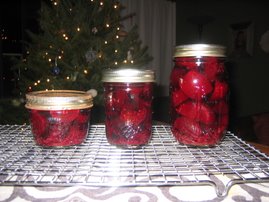
A few weeks ago, the wife of one of my softball teammates told me that she saw a recipe for pickled berries that she was interested in trying. She sent me the image of the recipe a few days later, and so when I saw these gorgeous red currants at the farmer's market this morning, I knew I had to try pickling them.
I found a Danish recipe, but it contained a preservative that I neither had nor wanted to use. And then I found an Alice Waters recipe adaptation which sounded more my style. I'm not sure yet what I'll do with them, but I have a few ideas. I could put them on a salad, serve them with some cheese and bread (Danish-style), but I'll most likely serve them alongside a venison and spaetzle.

Here's how I did it.

Pickled Red Currants
  
1 pint fresh red currants
1 cup champagne vinegar
1/8 cup sugar
10 each of juniper & allspice berries
1 stick of cinnamon
1 tsp pickling spices

Wash the jars out thoroughly with hot water, including the lids and place them near the stove. Wash your currants and place them carefully in the jars. Most of them will come off the stems, but leave some on the stems as they'll make a nice garnish in bunches. Chop your juniper and allspice berries on a cutting board. Add a bit of pickling spice to each jar. Bring the champagne vinegar, sugar, crushed berries, and cinnamon to a boil. (I added a dash of salt, too). Quickly pour the boiling liquid into the jars so that the berries are covered. Leave them to pickle for a few weeks before trying them in a dish.

Sunday, October 7, 2012

Ginger Rehab

You know you're cooked when you get that little tickle in your throat. Too late for the echinacea, too late for the Vitamin C. You just gotta stock up on the tea & cough drops and hope your schedule allows for a day or more resting at home. Mine didn't this time around. I had a 3-day retreat that I'd planned for my department in Albany, New York and a big party at home that Saturday night--neither of which I could cancel. Unfortunate, because in my experience, if you try to work through sickness with medication (my preferred coping meds are a steady stream of DayQuil and NyQuil), you're just staving off symptoms and your cold lasts longer. And that is, indeed, what happened.

What made this cold a tiny bit more bearable was the fresh ginger I picked up at the Albany food co-op. I'd never seen it before, and the co-op workers told me they wouldn't have it for long. I bought enough to do three things: make some ginger-tofu stir fry, stick one of the little root ends in water to see if it would grow, and cut little slivers into throat-coat tea all week. Delicious.

Saturday, September 15, 2012

Block Party Cubano Tacos

I've lived in the same place for almost 15 years in Brooklyn. Almost every year, our block has a party, but in years' past, I've been too busy to go. Recently, I've attempted to get involved in our newly-formed block association. I attend meetings when I can, but infrequently because of work. This year when the date of the block party was announced, I put it on my calendar and committed to go. Today was the block party, and I have never had more invitations to do different things: my softball team's party, a friend in from out of town, a colleague's birthday party--but I was committed to this block party. And I'm glad I made that decision.

Our block is really unique. There are people who've lived there all their lives, their apartments or houses were passed down through generations. There are entrepreneurs, families, same-sex couples, hipsters. There are people in new apartment buildings (three of them on the block), and some in crumbling brownstones. There's a hot new pie shop on the corner at one end of the block, and a reliable Chinese take-out on the other side that has a ginger and scallion soup that I swear cures the common cold. We have musicians who drum and play guitar on the roof every Saturday night, a motorcycle dude who annoys the hell out of me when he revvs his engine really loud, and the owner and founder of a local brewery. And even though I pass most of them by every day, I don't know very many of them at all.

I decided that I wanted to share my pickles and D's hot sauce this year, and made pernil as the platform. D happened to be away at a concert this weekend, but he cooked up a new batch of sauce and helped me roast the pernil last night. I made some pickles a few weeks ago, and had some pickled onions keeping in the fridge. So I made cubano-tacos: little corn tortilla halves, shredded jack cheese, shredded roast pork, pickle slice, pickled onions, and hot sauce. Folks were grilling with their families in front of their homes, so I went around and introduced myself and asked everyone if they wanted a little taco with some hot sauce.

People were so kind with their compliments and I got to talk to so many of them. My voting rights work, the state of the block's construction, the robust nature of the block association, and what "fracking" means were all little conversations I was able to have all day (D and I have a "no fracking" sign in our third-story window).

If I when I ever launch my pickle business, I'll start my marketing on my own block first.

Sunday, September 2, 2012

Don't Cry Over Spilled Hato Muji

I found this grain--Job's Tears, or hato muji, at the Albany food co-op several months ago. I'd never heard of it before, and it was supremely expensive, so I just had to try it. It is an ancient grain that looks and acts like barley, but isn't. It has all kinds of uses (medicinal, nutritional, artistic), but I planned to use it for a cold summer salad.

Ever since I stopped eating quinoa (here's why) I've been searching for an alternative grain. While hato muji is almost prohibitively expensive, it is really tasty.

I couldn't find a recipe for it anywhere, so I made one up based on a recipe I found for barley salad.

Apricot-Grain Summer Salad

1 1/2 cups hato muji
8 cups water
1 cube bouillion (veggie, mushroom)
[or you can use 2-4 cups of stock in place of the same proportion of water]
1/2 cup sliced dried apricot
1/2 cup shredded carrot
1 cup diced yellow pepper
1 cup finely diced onion
4 cloves diced garlic
1 tbsp diced ginger
2 tbsp olive oil, or toasted sesame oil (or a combination)
1/2 cup sliced toasted almond

Combined water/broth with the hato muji and bring to a boil. Simmer for at least an hour (frequently checking toward the end) until the grain is firm but chewy. While the grain is cooking, sautee in a cast iron pan the onion, garlic, and ginger in olive oil until tender and just beginning to brown. When the grain is done cooking, toss in a large bowl with the sliced apricots, shredded carrot, and the sauteed onion mixture. Quickly sautee over high heat the diced yellow bell pepper until some of the pieces are singed. Toss into the grain. Garnis with toasted sliced or chopped almonds. It's a nice alternative to a potato-based dish for a main dish of pork loin or ribs, or just on it's own.


Sunday, June 24, 2012

Alternative Pesto


Have you noticed how expensive pine nuts are? Oh my god. The last time I checked, they were well over $20 a pound. If you love pesto the way that I do, you will love this substitute that allows you to use a less expensive nut: walnuts. You can actually make pesto with hazelnuts and pecans, too (probably more, but I haven't tried any others). This is a delicious alternative to pine nut pesto. The next few weeks will be the best times to get fresh basil at the farmer's market. Make sure you pick up a bunch--if you make this recipe, you can freeze enough to keep yourself in fresh pesto through the winter.

Fresh Basil-Walnut Pesto

5 cups clean fresh basil leaves
1 1/2 - 2 cups parmesan cheese
2 cups walnuts
6 cloves of garlic
salt & pepper
1 - 1 1/2 cup olive oil
1/2 cup lemon or lime juice

Make sure your basil is washed thoroughly. I wash it, place the leaves in a bowl of cold water, and then stick it in the fridge til I'm ready to make the pesto. Start by placing about 1/4 of your basil leaves in a food processor along with about 1/4 cup of walnuts and 1-2 cloves of garlic. Once that has blended down, keep adding those three ingredients until they are all blended. Slowly add your oil until the mixture is a little loose; then start adding the cheese a portion at a time. Finish off with lemon or lime juice and salt & pepper to taste. Note: this is a really malleable recipe. You can use more or less of any of the above ingredients to taste. Just keep tasting your pesto until you get it just the way you like it.

Serve over your favorite pasta. We paired ours with some browned chicken breast, cherry tomato, and a lovely Long Island rose.


Wednesday, May 9, 2012

Where's the Pickles?

There's an ultimate frisbee tournament coming up and I'm fresh out of pickles. If you've ever been to an ultimate frisbee tournament, you've probably seen the guys on the sidelines after a few games chugging pickle juice straight out of the jar. Pickle juice is widely believed by athletes (though not yet scientifically proven) to relieve muscle cramping. I like bringing my homemade pickles to the fields so that after they chug down some neon green Vlasic pickle juice, the guys can enjoy a fresh, tasty, wholesome pickle.

I picked up a few pounds of kirbys today at the Albany Food Co-op, and decided that they deserve not some pre-packaged, stale pickling spice, but a fresh, homemade pickling spice. So I made some. I adapted it from a blog called Girlichef. It's worth making your own pickling spice if only for the smell of the toasted coriander and mustard seeds crushed in a paper bag that will linger in your kitchen.

Juniper Pickling Spice

4 Tbs. whole black peppercorns
4 Tbs. mustard seeds
4 Tbs. coriander seeds
2 Tbs. crushed red chiles
2 Tbs. whole allspice berries
1 tsp turmeric
2 small cinnamon sticks, crushed or broken into pcs.
24 bay leaves, crumbled
2 Tbs. juniper berries
1 Tbs. ground ginger

Lightly toast the first three ingredients in a small dry pan, slide them into a paper sack (like a brown lunch bag), and then roll over them with a rolling pin a few times. Combine cracked spices with remaining ingredients, mixing well. Store in a tightly sealed plastic container or glass jar. Then, make yourself some healing pickles. Best Dill Pickle Recipe as of May 2012 You'll need 4 or more pounds of kirbys; and at least four, if not six, canning jars. Make sure the jars and lids are squeaky clean. Some folks say you have to sterilize them, others take a short cut and put them in a dishwasher. I just do a very thorough wash with hot soapy water right before I begin the process. Soak whole kirbys in ice water for between 2-8 hours Make brine: 4 cups white vinegar 12 cups water 2/3 pickling salt 2 tbsp pickling spice 1 tsp turmeric 3 tbsp sugar Add to each jar: 2-4 cloves of garlic 2-4 sprigs of dill 1 tbsp of pickling spice 1/2 tsp turmeric While bringing the brine to a boil, cut the kirbys into spears. You don't want to do this beforehand because you want the pickles to stay crisp in the ice water til the very end. Pack the spears into the jars, and fill each jar to the top with the well-combined and boiling brine. Screw on the lids, and set onto tea towels until you hear the lids pop. Once they pop, the jars are sealed and can be stored at room temperature. If they don't pop, you need to refrigerate them and use them within a few weeks. Serve fresh from the fridge, or on ice from the jar on the frisbee field. : )

Monday, April 2, 2012

Preserving Lemons

A restaurant called Nomad on the Lower East Side serves the best couscous I've ever had. The secret? Little bits of preserved lemon. We ordered filet mignon brochettes (basically shish kebabs), served over this fabulous couscous. Meyer lemons were on sale at Fairway today, so I decided to try to make some myself. I have a lamb tagine planned in a few weeks, and I'd like to come close to making the best couscous we've ever had.

Moroccan Preserved Lemons

4 Meyer lemons, scrubbed very clean
1/2 cup kosher salt, more if needed
Extra fresh squeezed lemon juice, if needed
Sterilized quart canning jar

Place 2 tablespoons of salt in the bottom of a sterilized jar. One by one, prepare the lemons in the following way. Cut off any protruding stems from the lemons, and cut 1/4 inch off the tip of each lemon. Cut the lemons as if you were going to cut them in half lengthwize, starting from the tip, but do not cut all the way. Keep the lemon attached at the base. Make another cut in a similar manner, so now the lemon is quartered, but again, attached at the base. Pry the lemons open and generously sprinkle salt all over the insides and outsides of the lemons. Pack the lemons in the jar, squishing them down so that juice is extracted and the lemon juice rises to the top of the jar.

Fill up the jar with lemons, make sure the top is covered with lemon juice. Add more fresh squeezed lemon juice if necessary. Top with a couple tablespoons of salt. Seal the jar and let sit at room temperature for a couple days. Turn the jar upside down ocassionally. Put in refrigerator and let sit, again turning upside down ocassionally, for at least 3 weeks, until lemon rinds soften.To use, remove a lemon from the jar and rinse thoroughly in water to remove salt. Discard seeds before using. Discard the pulp before using, if desired. Store in refrigerator for up to 6 months.

Monday, March 5, 2012

Winter Slaw

My blog has been heavy on the meat and sweets lately, so I thought I'd bring it back to the roots and showcase a late-winter vegetable I found at the 5th Avenue Farmer's Market last weekend. Kohlrabi is a tuber-like vegetable that grows above-ground and is rich in vitamins and fiber and very low in calories--despite it's sweetness. There are a number of varieties, but the guy at the vegetable stand gave me a little slice of the purple kohlrabi to try, and I was sold. Kohlrabi is best to buy when the bulbs are relatively small, no more than 1 1/2 inches in diameter. They'll keep in the fridge for a week or so, but they are harder to grate the older they get.

I thought it would make a nice slaw as a light accompaniment to any of the meat dishes that we've been making. This week, we're serving it alongside some buffalo meatloaf, asparagus, and winter root vegetable mash. I actually threw the stubs of the kohlrabi (the pieces that you have to give up grating or else you end up grating your fingers and knuckles) into the winter mash as it cooked so I wouldn't waste anything.

I found this recipe which I adapted to accommodate the ingredients I had in the house.

Purple Kohlrabi Winter Slaw

2 medium kohlrabi, peeled, stems trimmed off, grated
2 carrots, grated
1/2 onion, grated
1/4 cup golden & black raisins
1 tbsp sugar
1 tsp salt
1 1/2 tbsp cider vinegar
4 tbsp chopped cilantro
1/4 cup mayonnaise (or more, if you prefer

Combine all ingredients in a bowl and mix well. Chill for several hours before serving.

Sunday, February 19, 2012

Pickled Red Onions

Soler's Pupusas food truck plates its pupusas with pickled red onions, jalapenos, and sour cream. They're so delicious that we had the proprietor Raphael Soler cater our wedding reception from his truck. Ever since we discovered his pupusas at the Red Hook ballfields, I've been saying that I wanted to make pickled red onions. Awesome in tacos, on arepas, and on top of burgers . . . it took me nearly two years to find the time to make them. A colleague turned me on to David Lebovitz's blog, where I found the best recipe for mint chocolate chip ice cream. I used his blog to find a simple recipe for pickled onions that I was finally able to make this afternoon.

Saturday, February 18, 2012

Weekend in the Country

The day after Thanksgiving, D's brother came to visit, and in return for a plate of leftovers, left us with two really nice cuts of freshly butchered venison that he had taken the last time he was out hunting around here. One of them was a loin, the other a backstrap. We prepared them both the same way--marinated in a nice olive oil, salt, pepper and some dried herbs for about a day. Then we pan-seared the meat in a skillet and finished it in a hot oven, ensuring that the meat was cooked but rare. The backstrap was a small piece of meat, but sliced thin and served with an apricot-mustard-brandy sauce alongside braised leeks and smashed sweet potatoes, it made a perfect winter meal for four.

Friday, December 30, 2011

Festivus Feast

For the past few years, I've been feeling like we need to go on a total cleanse diet after the holidays because we eat so much rich food between Halloween and the New Year. This year, we've been trying to celebrate in moderation to varying degrees of success. Kale is one of those restorative super foods (I've written about it here before), and has been looking pretty good at the farmer's markets this year. I've been trying to incorporate kale into a lot of the meals we eat for both of those reasons. Because I like to celebrate the hell out of every holiday, this is the meal we made for Festivus this year.

Tofu Stir Fry with Kale & Sweet Potato

1 8 oz package of firm tofu
1 sweet potato
A bunch of kale
4 large cloves
1 onion
1/4 of a head of green cabbage
1 small zucchini
olive oil
salt & pepper

Dry and gently squeeze the water out of the tofu and cut into bite-sized cubes. In a cast-iron skillet, heat some olive oil until smoking. Saute the onion and garlic until soft; add the cabbage and sweet potato and saute until tender. Then add the zucchini and kale until just wilted. Season with salt and pepper. Remove from the pan to a bowl and set aside. Heat a bit more oil in the pan and slowly brown the tofu cubes. When they are a nice golden color, add the vegetables back to the pan and heat through. We served this over Israeli couscous tossed with scallion, and a healthy side of kimchi.

Monday, September 5, 2011

End of the Line

When he was a kid, D's dad used to bring home 20 porgies at a time after fishing off the party boats in Canarsie. It was a good way for his dad to hang out with his buddies away from the wives and bring home food for his family. Who knows if you can even bring home 20 porgies at a time anymore? We've been eating less and less fish these days because of sustainability and toxicity concerns. We've also been searching for good information about what to eat and what not to eat, like this terrific NPR story that we heard by chance a few months ago about a book called Four Fishes. Tonight, we watched the movie The End of the Line, a documentary about overfishing featuring scientists predicting the extinction of many of the tastiest species. Porgies aren't one of those endangered fish, yet, but all of the experts advise eating less fish and trying to find sources that are committed to sustainable fishing methods.

Local is usually better. With that in mind, D and I trekked to Chelsea Market to get some fish at The Lobster Place after a day at the Highline Park, a park built on an old elevated former freight line (definitely worth a visit). At $4.50 a pound, the porgy--known for its tasty & firm white meat, locally fished, and not on the "Do Not Eat" list--was the fish to pick. We had 2 porgies filleted, and D prepared them for dinner. We garnished the fish with this black salt that we picked up at Williams Sonoma.

Seared Porgy with Corn & Olive Relish

1.5 lb fresh porgy, filleted
salt, pepper, olive oil
6 olives, chopped
one ear of corn, removed from the cob
small red pepper, diced
2 scallions, chopped
2 limes
1/4 stick of butter
splash of white wine

Saute in a cast iron pan the olives, corn, red pepper, and scallions in 1/4 stick of butter. Season with salt and pepper; finish with a splash of white wine and the juice of 2 limes. Season the porgy with salt and pepper and sear, skin side first, then flip to sear the other side. Pop it in the oven to finish. Serve on a bed of relish with some greens on the side (we used broccoli rabe). Enjoy!

Tuesday, August 23, 2011

Late Summer Harvest

Assembling fresh tomato, mozzarella, and basil takes just moments, but when the ingredients are just right, there's nothing better in the dog days of summer. (I know the Dog Days (of Summer) Are Over as of August 11th, but it sounded good). I picked up these lovely tomatoes and basil at the farmer's market on Sunday, and used them on Tuesday night. I stored the basil incorrectly, so very few of the leaves were worth using after two days in the fridge, but luckily enough leaves to accompany the tomato slices. The mozzarella was fresh-made at Fairway. Drizzle some quality salt, cracked black pepper, and a good deep green olive oil and you're good to go. Serve it on a pretty dish and you'll make you dining partner or dinner guests swoon. (This is served on one of a set of owl plates our friend Jess gave us as a wedding gift.) Next time, I would serve with a side of nice crusty/chewy bread to sop up the excess oil. Yum.